Definitions in the Radar Field
"A",
"B",
"C",
"D",
"E",
"F",
"G",
"H",
"I",
"J",
"K",
"L",
"M",
"N",
"O",
"P",
"Q",
"R",
"S",
"T",
"U",
"V",
"W",
"X",
"Y",
"Z"
"S" to "Sensi", "Senso" to "Spoi", "Spok" to "Sz"
Sensor: The receiver portion of a transmitter/receiver pair used to detect and process electromagnetic energy. [Sensors]
Shadow: A dead spot (minimum radiation) caused by the physical obstruction of transmitted waves
by a feed horn.
Shielding: The physical arrangement of shields for a particular component, equipment, or system, (A shield is a housing, screen, or other material, usually conducting, that substantially reduces the effect of electric or magnetic fields
on one side of the shield upon devices or circuits on the other side.) Examples are tube shields, a shielded enclosure or cabinet for a radar receiver, and the screen around a screen room.
Sideband: A signal either above or below the
carrier frequency, produced by the modulation of the carrier wave by some other wave.
Sidelobe: See Lobe, Antenna. [Antenna Dictionary]
Signal Strength: The magnitude of a signal at a particular location. Units are volts per meter or dBV/m.
Signature: The set of parameters which describe the characteristics of a radar target or an RF emitter and
distinguish one emitter from another. Signature parameters include the radio frequency of the carrier, the modulation characteristics (typically the pulse modulation code), and the scan pattern.
Silicon Controlled Switch: A P-N-P-N device able to operate at sub-microsecond switching speeds
by the application of gate signals. Because it is a four layer device, this switch is also known as a tetrode thyristor.
Slant Polarization: Technique of rotating a linear antenna 45E so it can receive or jam both horizontal and vertical polarization although there is a 3 dB loss.
Spectrum: The distribution of power versus frequency in an electromagnetic wave. See also Spectrum Signature Analysis and illustrations under Sideband.
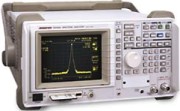
Spectrum Analyzer: An electronic device for automatically displaying the spectrum of the electromagnetic radiation from one or more devices. A cathode ray tube display is commonly used to display this power-versus frequency spectrum. [Test Equipment Manufacturers]
Spectrum Signature Analysis: The analysis of the electro-magnetic radiation from an electronic device
to determine the relative power in each sideband, harmonic, and spurious emission compared to the carrier frequency.
Spectrum Width: The difference between the frequency limits of the band which contains all the spectrum frequency components of significant magnitude.
Spherical Wavefronts: Waves of energy that spread out in concentric circles.
Spoiler Antenna: An antenna used to change (spoil) the antenna pattern of a second antenna so as to reduce
the nulls in the pattern of the second antenna. See also Null Fill.