Engineering Dictionary
"A"
"B"
"C",
"D",
"E",
"F",
"G",
"H",
"I",
"J",
"K",
"L",
"M",
"N",
"O",
"P",
"Q",
"R",
"S",
"T",
"U",
"V",
"W",
"X",
"Y",
"Z"
"B" to "Bas",
"Bat" to "Bim",
"Bin" to "Bn",
"Bo" to "Bq", "Br" to "Buq", "Bur" to "Bz"
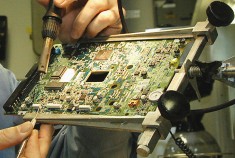
Board Holder. A vise or some or device to hold a printed circuit board [PCB] while being worked on; as in Solder/Desolder Applications. The holder may also be ESD safe or a Anti-static PCB Holder, but there are many styles. One example is shown to the right.
BOB. A Break-Out-Board [below], or a Break-Out-Box which inserts sample points, switches or indicators between two ends of a cable.
BOB Card. A Break-Out-Board is used to 'break out' or separate one style of interface into another via a Printed Wiring Board. |  BOB |
For example a BOB card may hold some type of connector [D-sub], but break those lines out to different headers or separate screw terminals. So a normal system cable will still connect to the BOB card using the connector, but each of the lines are now accessible for debug off the individual terminals.
Bode Plot. A graph of a linear, time-invariant system [gain or phase] versus frequency.
Body. That part of the component package exclusive of electrical terminals, studs, or leads. For example the metal can portion of a TO-5 transistor case.
Bolometer. A loading device that undergoes changes in resistance as changes in dissipated power
occur.
Bond. The permanent joining of metallic parts or circuits assuring electrical
continuity and capacity to safely conduct any current likely to be imposed.
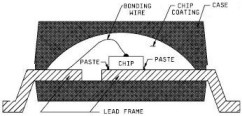
Bonding Pads. Metal pads arranged, around the edges, on a semiconductor chip used to accept bonding wires allowing a connection between the pins of a semiconductor and the semiconductor die. A metallized area to which an electrical connection is to be made.
Bonding Wires. Fine wires connecting the bonding pads of the chip to the external leads of the
package. Also refer to Wire Bond Failures, or terms used with Printed Wiring Board Construction.
Boolean. Pertaining to the operations of formal logic.
Boolean Algebra. A system of logic dealing with on-off circuit elements associated by such
operators as the AND, OR, NAND, NOR, and NOT functions.
Boot. A protective covering or coating over the interface between a cable and assembled connector.
Bootblock. A section of memory used to hold computer code intended to boot or load system code which is then used to operate the system. Boot block code may be stored in any form of memory, such as solid state memory or disk drive memory. When stored on floppy disk drives or hard disk drives the memory block is called a boot sector, referring to the sector the memory occupies on the disk.
Bootstrap. A circuit that brings it self into an operating condition or some desired state with out assistance, from another circuit.
Bootstrapping. See Bootstrap. A circuit using a capacitor to provide 100 percent feedback in a amplifier stage.
Boresighting. The alignment of a directional radar antenna, by using an optical procedure, to a fixed target.
Bounce Time. The time interval between first make of the contact until the uncontrolled making and
breaking of the contact ceases [switch or relays]. Also refer to Debouncing Definition
Boundary Conditions. The two conditions that the E-field and H-field within a waveguide must
meet before energy will travel down the waveguide. The E-field must be perpendicular to the walls and
the H-field must be in closed loops, parallel to the walls, and perpendicular to the E-field.
Box Fan. A style and shape of fan. A rotating fan housed within a square frame or enclosure. Also refer to a list of Companies producing Fans. Also see the definition of Fan for another graphic. |  |
Box Header. A term used to describe a Shrouded Header connector.

Box Header