Definitions of Radar Terms
"A",
"B",
"C",
"D",
"E",
"F",
"G",
"H",
"I",
"J",
"K",
"L",
"M",
"N",
"O",
"P",
"Q",
"R",
"S",
"T",
"U",
"V",
"W",
"X",
"Y",
"Z"
'La' to 'Lm', 'Lo' to 'Lz'
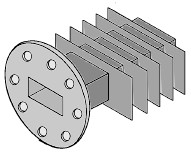
Load Termination: A termination is design to act as a load and absorb microwave energy when the actual load is not present. Also called a Dummy Load. An example load termination for a waveguide is shown below.
Lobe: An area of greater signal strength in the transmission pattern of an antenna.

Antenna Main Lobe Pattern
Lobe, Antenna: Various parts of the antenna's radiation pattern are referred to as lobes, which may be
sub-classified into major and minor lobes. The major lobe is the lobe of greatest gain and is also referred to as the main
lobe or main beam. The minor lobes are further sub-classified into side and back lobes as indicated in the figure to the right. The numbering of the side lobes are from the main lobe to the back lobe. Dictionary of Antenna Terms
Local Oscillator Frequency: An internally generated frequency in a super-heterodyne receiver. The local oscillator frequency differs from the receiver operating frequency by an amount equal to the intermediate frequency [IF] of the receiver. The local oscillator frequency may be either above or below the incoming signal frequency.
Logarithmic Receiver: A receiver that uses a linear logarithmic amplifier (lin-log) instead of a linear amplifier.
Log Video: This receiver process, generally implemented in the IF, compresses the dynamic range of the signal so both weak and strong signals are displayed without changing the gain setting. Output voltage can be calibrated in volts/dB of input power.
Long Pulse Mode: A long pulse mode is used to obtain high average power for long-range search or tracking, while a short pulse mode gives low average power for short-range, high-definition, tracking or search.
LORO: [Lobe-On-Receive-Only] A mode of operation generally consisting of transmitting on one non-scanning antenna system and receiving the reflected energy on another scanning system.
Low-Noise Amplifier: [LNA] A circuit designed to amplify low level signals with out adding an undo amount of noise. See Preamplifier.